PGT-A is an effective tool for screening embryos for aneuploidy, but it can fall short with other genetic defects like triploidy. This article aims to explain the capabilities and limitations of PGT-A and other genetic tests. It will also introduce some newer PGT-A technologies that are able to screen for triploidy and other defects.
First, let’s take a step back. You’ve probably come across a lot of unfamiliar but similar terms — preimplantation genetic screening (PGS), preimplantation genetic testing (PGT), preimplantation genetic diagnosis (PGD), PGT-A, PGT-M, PGT-SR — and asked yourself: “What exactly is preimplantation genetic screening and these other terms? How are they similar or different?”

Preimplantation Genetic Testing (PGT) is the umbrella term for all types of embryo testing. The following are types of PGT:
All these tests are designed to guide embryo selection. They help choose your embryos with the best chance for implantation success, and of developing into a healthy baby.
Let’s look at each of these before we get into the weeds of PGT-A specifically.
PGT-A stands for preimplantation genetic test for aneuploidy. Aneuploidy is a genetic defect in which there an irregular number of chromosomes in a cell – either extra or missing chromosomes. These tiny irregularities in the DNA gets amplified during development as the cells divide, often leading to miscarriage.
This is the most common embryo defect, and that’s why it’s the most common genetic test. But there are several other less common but impactful abnormalities that standard PGT-A does not test for.
PGT-A Mosaic Results and What They Mean
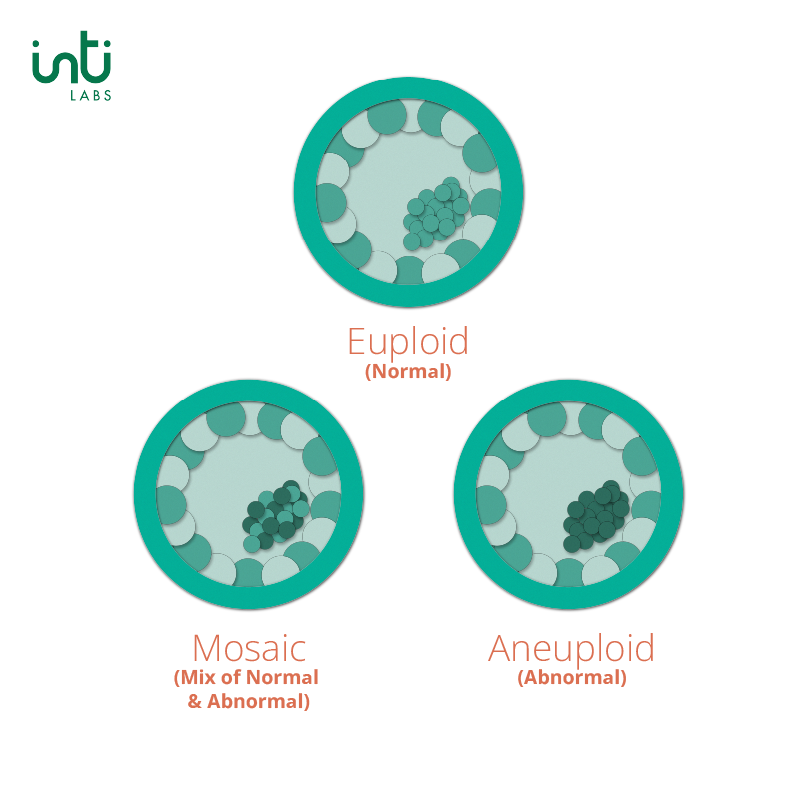
Standard PGT-A can show 3 possible results:
Euploid embryos are usually prioritized for transfer. Aneuploid embryos are generally not used. Mosaic results fall into a more uncertain category. Clinics will often err on the side of caution and avoid using mosaic embryos, unless there are no euploid embryos to choose from.
But that’s not the whole story! PGT-A results are based on a biopsy of only 5-10 cells from the outer layer of the embryo. This means that the result might not represent the entire embryo. On top of that, traditional PGT-A testing is like looking at a blurry photograph when it comes to mosaic embryos – it’s hard to see enough detail to make a clear call.
Many mosaic embryos develop into healthy pregnancies, but outcomes vary depending on the level and type of mosaicism.
Preimplantation genetic diagnosis — now referred to as PGT-M – is a test for parents who have a known history of monogenic mutations. Examples of monogenic disorders are Cystic Fibrosis, Sickle Cell Disease, and Huntington Disease.
PGT-M is more involved than PGT-A, requiring a DNA sample from each parent to develop a custom test. The PGT-M testing process can take weeks or months and is much more expensive than PGT-A (and doesn’t replace PGT-A). However, for families with a clear history of specific genetic risk, it can be invaluable.


Similar to PGT-M, PGT-SR is used when one or both parents have a known genetic condition – in this case, a chromosomal structural issue.
You can think of your chromosomes as books made up of chapters (genes). With structural rearrangements, the books might have chapters out of order, swapped between books, or pages missing.
While structural rearrangement issues are rare, those with related conditions will want to have their embryos screened, as it can lead to implantation failure or miscarriage with the embryo.
While the above tests can account for many of the more common genetic abnormalities that occur in embryos, there are a few other conditions that standard PGT-A, PGT-M, and PGT-SR are generally unable to detect.
Uniparental disomy (UPD) occurs when a cell inherits both copies of a chromosome pair from one parent — rather than the typical single copy from each.
This can lead to viable pregnancies and even healthy children, but depending on the chromosome affected, it has a greater chance of causing severe disabilities such as Angelman syndrome and Prader-Willi syndrome.
UPD doesn’t register with traditional PGT-A. To use a shoe analogy, PGT-A looks at a pair of shoes and thinks, “yep, there’s a pair of shoes”, without realizing that the pair is for two left feet.
Embryos typically have two sets of 23 chromosomes, for a total of 46 chromosomes
Triploidy is a rare condition (affecting 1-3% of all pregnancies in the US) which occurs when there is an entire extra set of chromosomes present in the cell (69 total), leading to severe complications like a partial molar pregnancy.
Haploidy is when there is a whole missing set of chromosomes in the cell (23 total). It is even more rare than triploidy but equally non-viable.
Traditional PGT-A is not comprehensive enough to catch this. The expression “can’t see the forest for the trees” applies here – PGTA is so focused on minor details, comparing one chromosome to another, that it misses the fact that there is a whole extra or missing set.
A triploid pregnancy will almost always end in miscarriage, but it is possible for a child to be born with triploidy. However, this is a life-threatening diagnosis and most born with the condition will not survive beyond a few months.
In the exceedingly rare cases that a child has a less severe form of triploidy and makes it to adulthood, their life will likely be one of hardship. For this reason, triploid embryos are considered non-viable.
There are now more advanced PGT-A tests that give more information than simply aneuploidy, euploidy, and mosaic. Some of them, like Pixl Next Generation PGT-A, can reliably identify triploidy, haploidy, UPD, and other genetic abnormalities. They do this through SNPs.
SNP stands for Single Nucleotide Polymorphism, and these are one of the most important ways that DNA differs from person to person. Without SNPs, humans would be much more genetically similar.
Most SNPs don’t manifest in any noticeable way, and most of those that do have no impact on health. Some of them, however, serve as indicators (or biomarkers) for certain diseases and conditions.
SNP-based PGT-A tests look at carefully chosen SNPs in the embryo to identify specific abnormalities and clarify mosaic results. To use our previous example of the blurry image, Pixl’s SNP-enhanced technology allows us to sharpen that blurry image to get a more precise understanding of the embryo’s viability.
Newer PGT-A tests have a built-in ploidy status feature that can detect haploidy and triploidy. If you’ve experienced a failed IVF cycle previously, even after using a more traditional PGT-A testing, it’s possible that the test wasn’t able to detect ploidy status.
There are many possible causes for a failed cycle, but with modern PGT-A tests like Pixl, you can more effectively screen embryos to control this variable in the IVF process.
Though still a newer capability of some PGT-A tests, UPD detection can screen embryos for uniparental disomy – when both sets of chromosomes are inherited from one parent.
UPD does not always lead to genetic complications – in fact, in many cases it won’t. But when deciding between multiple options during embryo selection, you and your doctor may choose to prioritize embryos that don’t carry the risk of UPD.
Most traditional PGT-A tests rely on something called Copy Number Variation (CNV) analysis. This method looks at the overall number of copies of each chromosome, helping identify whether there are extra or missing chromosomes.
Today, both CNV and SNP analysis are performed using advanced NGS data analysis. While CNV focuses on the quantity of DNA, SNP analysis looks more closes at specific genetic markers to understand how that DNA is inherited.
Together, these approaches can provide a more complete picture. But CNV on its own may miss certain complex genetic issues – this is why combining both types of analysis can lead to a more accurate assessment of embryo health.
Pixl is an SNP-enhanced PGT-A test that performs the same aneuploidy testing as standard PGT-A, plus:
· Provides more complete and accurate information on mosaic embryos, potentially giving you more viable embryos
· Tests for ploidy status, saving you from the heartache of a potential miscarriage
· Includes UPD detection, to avoid conditions like Angelman and Prader-Willi syndromes
· Verifies results with dual-layered traditional PGT-A and SNP analysis for increased accuracy
Screens for a preselected panel of the most common monogenic mutations and microdeletion syndromes, adding an additional layer of reassurance
With some chromosomal abnormalities, miscarriage is not guaranteed. It’s still possible to have a successful pregnancy and healthy baby, with certain chromosomal abnormalities.
Mosaic embryos can develop normally, and even certain abnormalities like UPD often won’t lead to any genetic defects. PGT-A testing is simply a tool to screen embryos and choose those most likely to develop in a healthy way.
Your IVF doctor is the best resource for assessing risk based on test results.
· Standard PGT-A can only test for euploidy, aneuploidy, and mosaicism
· Triploid and haploid embryos are non-viable, most often resulting in failed IVF cycles – either from implantation failure or miscarriage
· Newer PGT-A tests can test ploidy status to identify triploidy and haploidy
· Pixl Next Generation PGT-A can also test for UPD and some of the more common monogenic mutations (a “mini” PGT-M)
· Not every genetic abnormality found in an embryo will lead to miscarriage or genetic conditions post-birth, but this information is very useful when choosing embryos to transfer